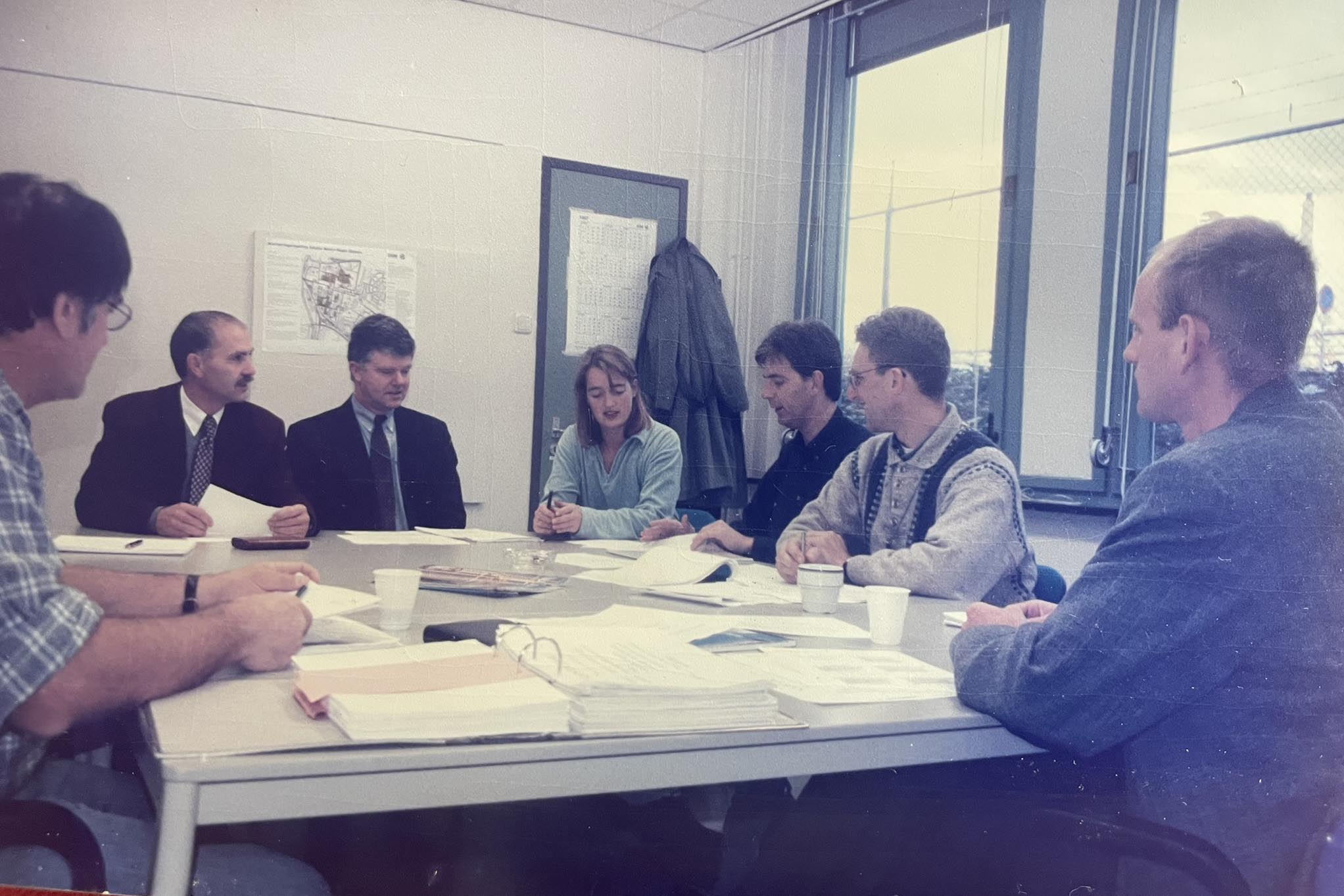
There is a photograph on the wall next to my workplace at home.
At first sight, there is not much to it. It shows a small, rather bare conference room, with my team and me sitting around a table, together with an HR colleague and a consultant. On the table are some documentation folders and the ubiquitous white plastic coffee cups. There is little else in the room.
The photograph was taken arouind 1997 during a period when we were being coached in a new way of working: empowerment.
It was actually published in DSM Nieuws, the company’s internal newspaper, as an example of the work we were doing.
At the time, our team had quite a challenge. We were dealing with the “child diseases” of the newly started phenylglycine-amide plant that used a new technology. The business need of getting the plant to run properly put considerable pressure on the team — and on me as its leader.
The empowerment coaching therefore wasn’t some theoretical management exercise. We had real problems to solve and real pressure to deliver.
Two sides of empowerment
I experienced the coaching from two different sides.
As the team leader, I learned a different way of leading people.
The lesson was not simply “give people freedom”. It was more subtle: don’t prescribe; challenge.
Instead of telling someone how to solve a problem, I should challenge them to think through the problem themselves. What are you trying to achieve? What have you considered? What prevents you from getting there? What alternatives do you see?
The responsibility for the solution remained with the professional doing the work.
But I was also being coached from the other side — as a team member myself.
The HR colleague and consultant would sometimes accompany me when I had to go to my own manager to ask for money, people or other resources. I was learning how to operate within the organisation in the same way that I was learning to lead my own team.
The message was essentially the same in both directions.
I had responsibility for an outcome, but I also had to take responsibility for finding the way to achieve it.
That meant making a case for what I needed, challenging assumptions, negotiating for resources and taking ownership of the result.
The photograph returns
At the time, I probably did not think of the photograph as particularly important. It was simply a picture of a team, an HR colleague and a consultant, documenting one of DSM’s empowerment initiatives.
Almost twenty years later, it came back to me.
MyDSM departmenthad moved into a new building with open offices. There were no cupboards for storing large quantities of paper, so we had to get rid of much of the paper that had accumulated over the years.
The same HR colleague moved into the new building with us. While clearing out his own paper archive, he came across the photograph.
He gave it to me.
I was very happy to receive it.
It was a small piece of my professional history that had unexpectedly survived the transition to a paperless office.
And it is still on the wall next to my workplace today.
What I learned
Looking back, the most important thing about the photograph is not the plant, the team or even the empowerment programme itself.
It reminds me of a way of working that became deeply ingrained in me.
The basic idea was remarkably simple:
The what is given.
The how is yours.
You are given a goal, a timeframe and the constraints within which you have to operate. Then you are expected to work out how to achieve the goal.
As a leader, your job is not to prescribe the solution. Your job is to challenge, coach and remove obstacles.
As a professional, your job is not to wait for instructions. You are expected to use your expertise, creativity and judgement to find a way forward — and to take responsibility for the result.
After a while, this stops feeling like a particular management philosophy. It becomes what you consider normal.
That happened to me.
I only realized this much later
When I received the photograph, Covestro was still far in the future. I had no reason to connect this small piece of DSM history with anything that would happen later in my career.
On 1 April 2021, the DSM business I had worked in moved to Covestro. I followed it.
The plants were largely the same. Many colleagues were the same. The technical problems were the same.
But the organisational environment was different.
And that is when the photograph acquired a new meaning for me.
It made me realize that what I had come to regard as a normal way of working was not simply how professional organisations work. It was the result of a particular culture in which I had spent more than thirty years.
I had been trained in empowerment — not just intellectually, but through actual experience, pressure, coaching and practice.
And I had carried those instincts with me.
From empowerment to intrapreneurship
There is another consequence.
If you are given the objective but are allowed to determine how to achieve it, you inevitably start operating a little like an entrepreneur inside the organisation.
You have to find the right people, obtain resources, build relationships, overcome obstacles and make things happen. You cannot simply say that the prescribed solution doesn’t work. The outcome is yours.
I now recognize this as a form of intrapreneurship.
It also explains something about the little “shop” I described in my earlier post: why it felt quite natural to me to take ownership of a small domain within Covestro and run it with considerable independence.
I did not set out to become an intrapreneur. By then, I had simply been working that way for a very long time.
For now, the photograph remains on my wall.
A photograph from around 1997, rescued from a paper archive almost twenty years later, has become a reminder of something I didn’t fully appreciate at the time:
The most lasting part of empowerment is not what you are taught. It is what eventually becomes your instinct.
And that instinct stayed with me for the next thirty years.