When I look back at my years at DSM, I realise that I experienced the development of its management culture in a rather peculiar way.
At the time, I did not see a grand design.
Things happened one after another: a reorganisation where central departments were resolved, management training, new ways of setting goals, new work processes, new roles. Managers behaved in ways that gave us more room to take responsibility. We learned new techniques and gradually started working differently.
Only much later did I begin to see how these things fitted together.
From a central department to the business
I joined DSM on 1 November 1990, in the central process-control department of the Division Chemicals.
I did not stay long in that organisation.
On 1 January 1992, the Division Chemicals was dissolved and its activities were reorganised into Business Units. I moved into the plants of the Special Products Business Unit.
For me, this was an important change in perspective.
I had moved from a central department of a large division into what felt much more like a small company within the company, with only a few hundred employees. I was suddenly much closer to the plants and to the business itself.
My work also broadened.
I became involved in the plants’ budgeting and planning process. One of my tasks was to assemble the data for the three-year operational plan.
We developed a base scenario: what would happen if the plants continued with their current performance, taking account of turnarounds and expected on-stream time?
Then there was a three-year scenario based on what we expected to happen.
For that I needed market-development estimates from the product managers. I also needed the improvements that were expected to come from our improvement portfolio, which I managed together with a small team of engineers.
So I was increasingly connecting things that had previously seemed separate:
plant performance, improvement, market expectations, production capacity and business planning.
I didn’t realise it at the time, but this was already part of a broader change in the way responsibility was organised.
Learning to manage differently
There was also a substantial investment in management development.
I attended DSM’s Basic Management and later Middle Management programmes. These were not just classroom courses. We worked in groups, including outdoor exercises, and discussed subjects such as the psychology of leadership. We were also introduced to Strategic Dialogues.
There were other programmes as well.
I remember one particularly well about setting goals. It was led by a Belgian teacher who, as we were told, also trained people at the Vatican.
The interesting question was not simply how to formulate a goal.
It was:
What makes a goal useful?
A useful goal should be constructed so that achieving the goal and achieving the desired ultimate performance go hand in hand. A target that can easily be achieved while producing the wrong behaviour is not a very useful target.
These sessions also created something less tangible but perhaps just as important: relationships.
Managers from different parts of DSM met each other, worked together and got to know each other. We learned intervision — discussing management problems with peers and helping each other think through possible solutions.
A management community was being created across organisational boundaries.
A small Geleen interlude
After the control-room project, I had taken a short break in Scotland with my brother-in-law and some friends. That was where I had my first golf lessons.
When I came back to Geleen, I mentioned this to two colleagues. They immediately became enthusiastic. It turned out that there was a small golf course nearby, with a teacher.
So we decided to take lessons together. Every week, after the morning meeting and before lunch, the three of us would drive there for our golf lesson.
We did have clock cards, but we also had accumulated so many surplus hours that this was hardly difficult to justify.
I never became a serious golfer, but I remember the experience fondly. It was one of those things that happened almost naturally: we were serious about our work, but there was room to do something together simply because we enjoyed it.
It was perhaps a small example of the atmosphere in Geleen at the time.
Then came the work processes
In 1998/99, DSM introduced a more formal framework of work processes, roles, meeting structures and KPI definitions. I remember that we were told the approach had been inspired by Dow Chemical.
The work processes included, among others:
- Operate Plant Normal
- Asset Utilization
- Improve Plant
- Do Maintenance
- Increase Equipment Reliability
- Small Projects.
These were not just descriptions of activities.
The idea was to clarify roles and responsibilities, create a structure for meetings and alignment, define how issues should be escalated and make performance visible.
And the work processes complemented empowerment.
The role was not supposed to become a detailed list of tasks that someone had to execute. The person in the role was expected to take responsibility for the result.
I remember lengthy discussions in our department about the meaning of “roles”. Some people found it difficult to see how a role differed from the traditional Dutch taken, bevoegdheden en verantwoordelijkheden — tasks, authorities and responsibilities.
The difference was subtle but important.
A traditional task description tells you what you are expected to do.
A role gives you responsibility for an area or result and leaves considerably more room for deciding how to achieve it.
That distinction turned out to be important for me.
Empowerment was not being left alone
There is another part of this story that I should make explicit.
When I describe the projects I subsequently led, it might sound as if I was simply given a lot of freedom and went off doing my own thing.
That wasn’t how it worked.
I had support and trust from my managers.
The coaching described in The photograph on my desk is a good example. The HR person and consultant did not only coach me in how to empower my own team. They were also there when I had to go to my manager and ask for money or other resources.
That was an important part of the system.
Empowerment does not mean:
“Here is your responsibility. Good luck.”
It means something more like:
“You are responsible for the result. You have room to determine how to achieve it, and we will support you when you need the organisation to make that possible.”
Of course, DSM was far from perfect. There were disagreements, bureaucracy and plenty of things that didn’t work as intended.
But there was a consistent direction.
Management was increasingly expected to set objectives, provide the framework, challenge people and remove obstacles, while people closer to the work were expected to take responsibility for achieving the result.
Looking back
Only in retrospect do I see how many pieces were reinforcing each other.
There was the reorganisation into Business Units, bringing responsibility closer to the business.
There was management development, giving managers a common language and new ways of thinking about leadership.
There were Strategic Dialogues and goal-setting, connecting objectives with business performance.
There were roles and work processes, giving the new way of working an organisational structure.
And there was management support and trust, making it possible for people to actually exercise the responsibility they had been given.
None of these things, by itself, creates an empowered organisation.
Together, they can.
At the time I didn’t know whether this was a carefully designed master plan or simply a series of initiatives that happened to fit together.
Much later I discovered that there really had been a much more deliberate transformation behind it.
But that is another story.
What I do know is that, by the time I became involved in the control-room projects, empowerment had become part of the way I instinctively approached work.
I didn’t think:
“Now I am going to apply the DSM empowerment philosophy.”
I simply thought:
Here is the objective. Now let’s work out how to make it happen.
A different kind of responsibility
In 1999, corporate DSM asked us to prepare for the millennium change. The concern was that somewhere in the company there might be a computer with a clock that would not cope correctly with the transition from 1999 to 2000.
I became project lead for the investigation — not only for the new control room, but for the systems throughout our plants.
We had to find all the systems for which the date could potentially matter and make sure they would survive the change. The final test of our part of the work was almost wonderfully simple: we performed the millennium change in our little DCS and watched what happened.
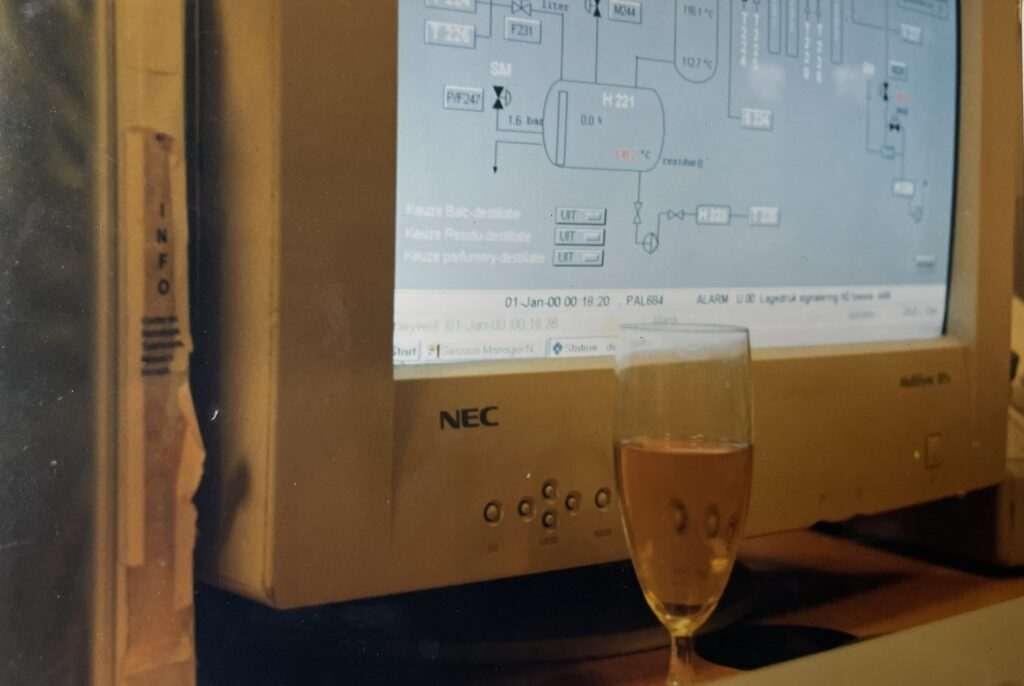
I still have a photograph from that moment. It shows the DCS screen displaying 1 January 2000, together with a glass of alcohol-free champagne that had been sent to the centre to mark the completion of our part of the project.
But finishing our own test did not mean that I could go home.
On New Year’s Eve I was in the control room for almost the entire night. We had to wait for the green light from all the relevant sites and from the energy companies before we could finally declare everything safe and release the operation.
So while most people were celebrating the arrival of the new millennium, I was waiting for green lights.
Eventually, sometime after four in the morning, I could go home.
I remember coming back into our street and seeing everybody asleep. Normally we would have celebrated New Year’s Eve together.
But by then it was already past four.
I had rather literally missed the millennium while making sure that the company could experience it safely.
And that is where the Rotterdam control-room story begins.