There was one more, rather unexpected, part of the Rotterdam control-room project.
We had a budget for a piece of art for the new control room.
I had worked closely with the operators during the project, and one of them was particularly interested in finding an artist who could create something suitable. So I let him take the lead.
He arranged meetings with several artists, and I went along with him.
This took us to some of the strangest places in Rotterdam: artists’ studios and workplaces that were about as far removed from a chemical plant as you could imagine. We looked at portfolios, discussed ideas and listened to the artists explain what they might do with the space. They put quite some work into their proposals.
Eventually, we chose one.
From the plant to the molecular level
The result was a large wall painting in the control room.
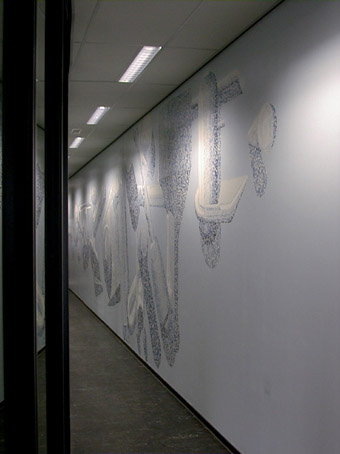
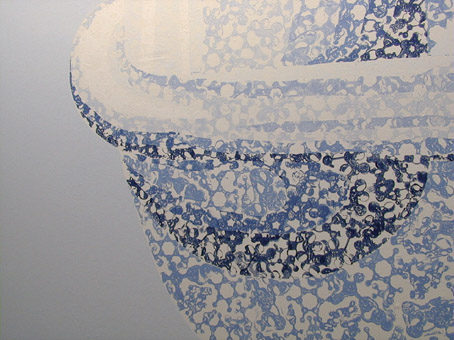
The idea was to create the image using stamps of different objects. There was a whole box of them — I remember seeing all these different shapes together.
The painting had a kind of progression from left to right. At one end were very large objects, such as the Erasmus Bridge in Rotterdam. As you moved across the painting, the objects became smaller and smaller, until at the other end they were molecules — including molecules of products that were made in Rotterdam.
From a distance, all those individual stamps merged into an image of the plant and its equipment. When you came closer, you could see what the larger picture was actually made of.
I particularly liked that idea. The plant could be seen at two different scales: as a complete installation from a distance, and as the individual objects and molecules that made up the process when you looked more closely.
The artist even let me choose one of the stamps as a souvenir.
I chose the Erasmus Bridge.
I still have it.
The opening
When the new control room was officially opened, it was a much bigger event than the opening of a new workplace.
So many things had come together in the project: the consolidation of two control rooms, the new automation, the move from conventional panels to screen-based operation, the redesigned operator roles and the associated changes in the organisation and ways of working.
The opening therefore felt like a landmark event — almost a fresh start for the plant.
It was a moment when you could look at the new control room and see the future you had been working towards for several years.When the new control room was officially opened, I invited the artist to the ceremony.
He then asked me a slightly unexpected question:
Could he bring some fellow artists?
His reason was perfectly understandable. The control room was normally not accessible to them, and this would probably be their only opportunity to see the work in its final setting.
Of course, I said yes.
And so they came.
I don’t think I had ever seen such a bunch of colorful people at a DSM event.
There were operators, engineers and managers in their usual industrial surroundings — and now a group of Rotterdam artists had joined them.
It made for a rather unusual gathering.
Looking back
What I find interesting about this story now is not so much the artwork itself.
It is how it came about.
We had a budget and an objective: put some art in the new control room.
But I didn’t decide what the artwork should be. An operator took the initiative, found people with expertise I didn’t have, explored the possibilities and helped choose the result.
I trusted him to do it.
That was, in a very small and perhaps slightly absurd way, the same principle we were trying to apply to the rest of the organisation:
The what was given. The how was yours.
And sometimes the result is something you would never have designed yourself.
There is a small irony to this story that I only noticed much later.
One of Covestro’s C³ values is Colorful.
I have to admit that we managed to make a control-room opening pretty colorful at DSM too — without putting it in the corporate values first.