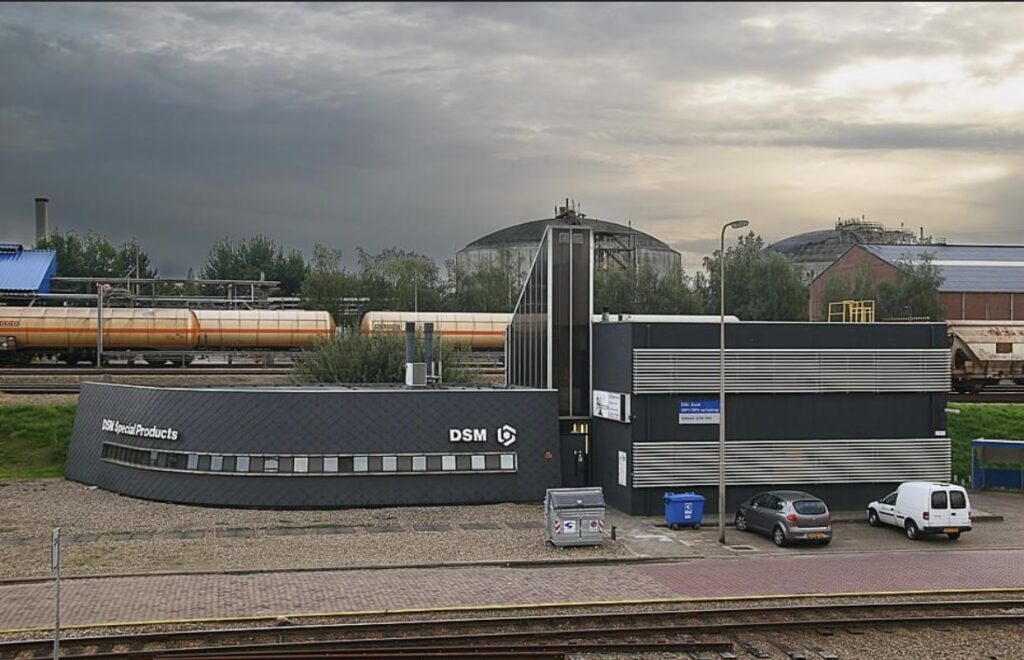
There was one more, rather unexpected, part of the Rotterdam control-room project.
We had a budget for a piece of art for the new control room.
I had worked closely with the operators during the project, and one of them was particularly interested in finding an artist who could create something suitable. So I let him take the lead.
He arranged meetings with several artists, and I went along with him.
This took us to some of the strangest places in Rotterdam: artists’ studios and workplaces that were about as far removed from a chemical plant as you could imagine. We looked at portfolios, discussed ideas and listened to the artists explain what they might do with the space. They put quite some work into their proposals.
Eventually, we chose one.
From the plant to the molecular level
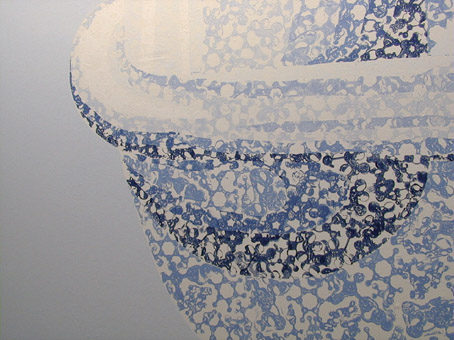
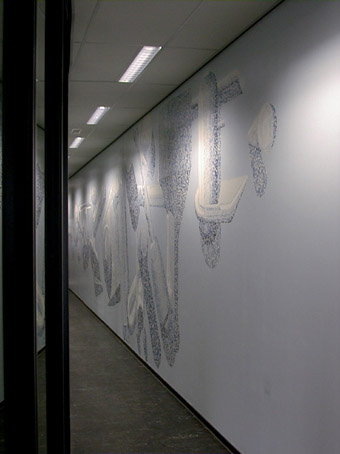
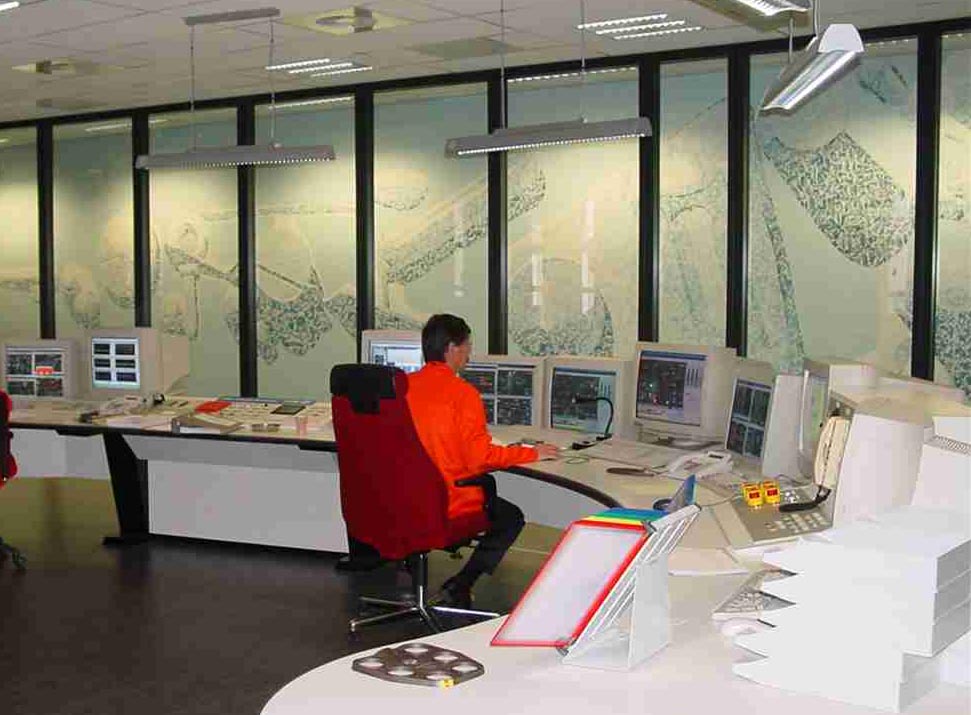
The result was a large wall painting in the control room.
The idea was to create the image using stamps of different objects. There was a whole box of them — I remember seeing all these different shapes together.
The painting had a kind of progression from left to right. At one end were very large objects, such as the Erasmus Bridge in Rotterdam. As you moved across the painting, the objects became smaller and smaller, until at the other end they were molecules — including molecules of products that were made in Rotterdam.
From a distance, all those individual stamps merged into an image of the plant and its equipment. When you came closer, you could see what the larger picture was actually made of.
I particularly liked that idea. The plant could be seen at two different scales: as a complete installation from a distance, and as the individual objects and molecules that made up the process when you looked more closely.
The artist even let me choose one of the stamps as a souvenir.
I chose the Erasmus Bridge.
I still have it.
The opening
When the new control room was officially opened, it was a much bigger event than the opening of a new workplace.
So many things had come together in the project: the consolidation of two control rooms, the new automation, the move from conventional panels to screen-based operation, the redesigned operator roles and the associated changes in the organisation and ways of working.
The opening therefore felt like a landmark event — almost a fresh start for the plant.
It was a moment when you could look at the new control room and see the future you had been working towards for several years.When the new control room was officially opened, I invited the artist to the ceremony.
He then asked me a slightly unexpected question:
Could he bring some fellow artists?
His reason was perfectly understandable. The control room was normally not accessible to them, and this would probably be their only opportunity to see the work in its final setting.
Of course, I said yes.
And so they came.
I don’t think I had ever seen such a bunch of colorful people at a DSM event.
There were operators, engineers and managers in their usual industrial surroundings — and now a group of Rotterdam artists had joined them.
It made for a rather unusual gathering.
Looking back
What I find interesting about this story now is not so much the artwork itself.
It is how it came about.
We had a budget and an objective: put some art in the new control room.
But I didn’t decide what the artwork should be. An operator took the initiative, found people with expertise I didn’t have, explored the possibilities and helped choose the result.
I trusted him to do it.
That was, in a very small and perhaps slightly absurd way, the same principle we were trying to apply to the rest of the organisation:
The what was given. The how was yours.
And sometimes the result is something you would never have designed yourself.
There is a small irony to this story that I only noticed much later.
One of Covestro’s C³ values is Colorful.
I have to admit that we managed to make a control-room opening pretty colorful at DSM too — without putting it in the corporate values first.
In 2000, I moved to DSM Rotterdam in the Botlek. But Rotterdam was not where I first became involved in centralizing control rooms.
That had started a few years earlier in Geleen.
The Geleen site was quite different from Rotterdam. It consisted of a collection of relatively small plants, many of which were still operated locally from conventional control panels. I had developed the idea of bringing these operations together into a single control room.
For quite some time, nothing happened with the idea.
Then a consultancy came in looking for opportunities to reduce costs.
Suddenly, my old proposal became interesting.
I was asked to work out how it could be implemented. The idea combined automation — using a mini-DCS — with consolidation of the local control rooms into one central control room.
A project manager was appointed, and I became part of his project team.
Designing a control room is not only an engineering exercise
One of the interesting decisions the project manager made was not to leave the design of the new control room entirely to engineering.
Instead, he brought in an architect.
From earlier experience, I knew that another discipline could contribute something important as well: ergonomics. A control room is, after all, a workplace in which people have to monitor processes, recognise abnormal situations and make decisions, often under pressure.
So an ergonomist was brought into the project too.
The architect and the ergonomist approached the design from quite different perspectives. There was some tension between them — which was perhaps inevitable.
But both contributed something valuable.
The architect helped create a control room that was an imposing and coherent space. The ergonomist brought the perspective of the people who would actually have to work there.
In the end, the two perspectives came together in a design that was both visually impressive and suited to the needs of its users.
That experience stayed with me.
Rotterdam: Lifetime Extension and Redesign Process Control
The Rotterdam project was considerably larger. The complete old plant was being revamped, including the control system, and the project team included people from several contractors.
One of the things I learned from the project manager was that a project team does not automatically become a team simply because everybody has been assigned to the same project.
He deliberately worked on that. He organised regular activities in which people met outside the immediate project work: barbecues at the beach at Rockanje, and team-building events, including one in the Ardennes and another at Papendal, the national sports centre.
These things might sound peripheral compared with the technical complexity of the project. I did not experience them that way. They helped turn people from different companies into one project team.
I learned a lot from that project manager, including something that stayed with me much later:
cooperation has to be created; it does not automatically follow from an organisation chart.
By the end of the project, much of the contractor organisation had disappeared again, and I became the project manager for the remaining control-room work. By then I had seen the project from both sides: as somebody being guided by an experienced project manager and, eventually, as the person responsible for bringing the remaining work together.
The new control room
I had become the project manager for the consolidation of two existing control rooms. This was the final step that only was possible because of the previous steps in the overall project.
And I could bring the lessons from Geleen with me.
The Rotterdam project was considerably more than putting two control rooms together. One of the existing control rooms was already large, with extensive conventional instrumentation arranged in large panels. The other had its own control environment.
In the new control room, all of that conventional instrumentation disappeared.
The plant would now be operated entirely through screens. There had been screen-based operation before, but this was a fundamental change: the operators would no longer have the physical overview provided by the traditional panels.
At the same time, we had to redefine the operators’ roles and assess people for the new roles.
So we were changing three things simultaneously:
the physical organisation of control;
the technology through which operators interacted with the plant;
the roles and organisation of the people operating it.
This was where the work-process model, automation and empowerment came together.
What happened after implementation
Once the new control room was operational, something happened that I found particularly interesting.
The operators started asking for things.
They would notice that a particular piece of information was useful to them but wasn’t yet available in the form they wanted. They would ask for a display, an analysis or another tool that would help them understand what was happening in the plant.
We had a historian system containing large amounts of process data, and we had provided tools with which displays could be built.
The operators started using them.
Rather than waiting for engineering or IT to develop everything for them, they began creating displays themselves, using the data that were already available.
This was particularly interesting because we had just taken away something they had previously had: the immediate visual overview provided by the conventional control panels.
Instead of simply accepting the new screen-based environment, they started shaping it to suit the way they needed to operate.
And then it went further
What surprised me was that the operators didn’t stop at process displays.
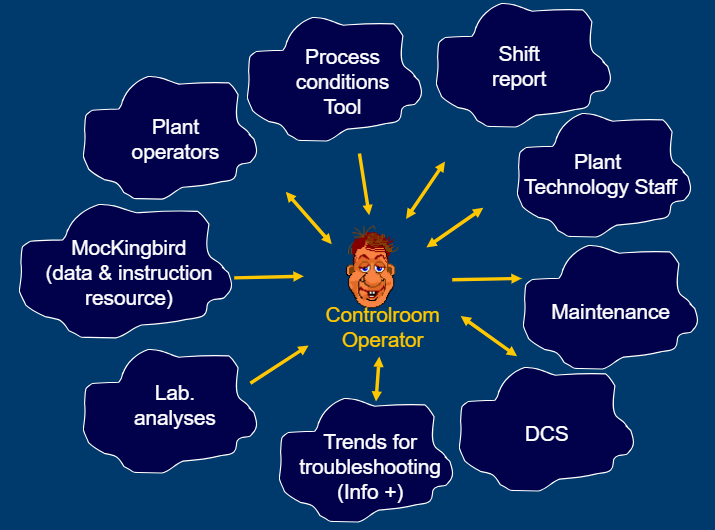
They began thinking about the information they needed as a whole. One of the operators even made a picture of the information environment around the control-room operator.
The operator is shown in the centre, connected to the different sources and tools needed to operate and troubleshoot the plant: the DCS, trends, laboratory analyses, a process-conditions tool, shift reports, maintenance, plant technology staff, other plant operators and a resource called Mockingbird, containing data and instructions..
The picture is interesting because it wasn’t an IT architecture diagram produced by an IT department. It was an operator’s view of the information environment needed to do the job.
And the operator didn’t just draw the picture. Using the simple tools we had made available, operators started building parts of this environment themselves.
One example was Mockingbird, a resource where documents could be stored and links could be created between related documents. Other tools brought together process data, trends and other information needed for troubleshooting.
By today’s standards, none of this was particularly sophisticated technology. But that wasn’t the point.
The people doing the work had identified what information they needed and started shaping the tools around their work.
Nobody had instructed them to develop an information system.
They simply saw an opportunity and took it.
The control-room operator at the centre
Looking back, I think the picture captures something important about the change we were trying to make.
The new control room had made the operator responsible for a much broader operating environment. The old control panels had provided a very tangible overview of the process. Now the operator had to construct that overview from information presented through screens and other systems.
But instead of simply asking someone else to design the perfect interface, the operators started building the information environment they needed.
This was empowerment in a very practical form.
We had provided the framework, the process data and some relatively simple tools. The operators provided the detailed knowledge of what was useful in their work.
The result was something neither side could have designed as well on its own.
This was empowerment in practice
Looking back, I think the important part was the combination of things we had done.
We had given people new roles and responsibilities, but we had also given them information and tools with which they could fulfil those responsibilities.
And then we allowed them to shape the tools themselves.
The work-process model provided the organisational framework. The new control room provided the environment. The historian provided access to information about what was actually happening. And the development tools gave operators the ability to turn that information into something useful.
This was a very practical demonstration of something I had learned through the empowerment coaching several years earlier:
Don’t prescribe the solution. Give people the responsibility and the means to find it.
Taking the experience further
A few years later, these experiences became relevant to the integration of the former Roche Vitamins business into DSM, which became DSM Nutritional Products.
Central control-room consolidation was one of the elements being considered as part of the integration and cost-reduction programme. The experience we had gained in Rotterdam therefore became useful beyond the original plant.
One of the Rotterdam operators had been particularly enthusiastic about using the new tools and developing his own solutions.
We invited him to become involved in the integration work and, in particular, to help train colleagues in the newly integrated organisation.
That was significant to me.
We could have sent an IT specialist to explain the technology. Instead, we took someone who had used the technology to improve his own work and asked him to show others what was possible.
You don’t teach empowerment by explaining the word.
You let people experience what becomes possible when they are given responsibility, information and the means to act on it.
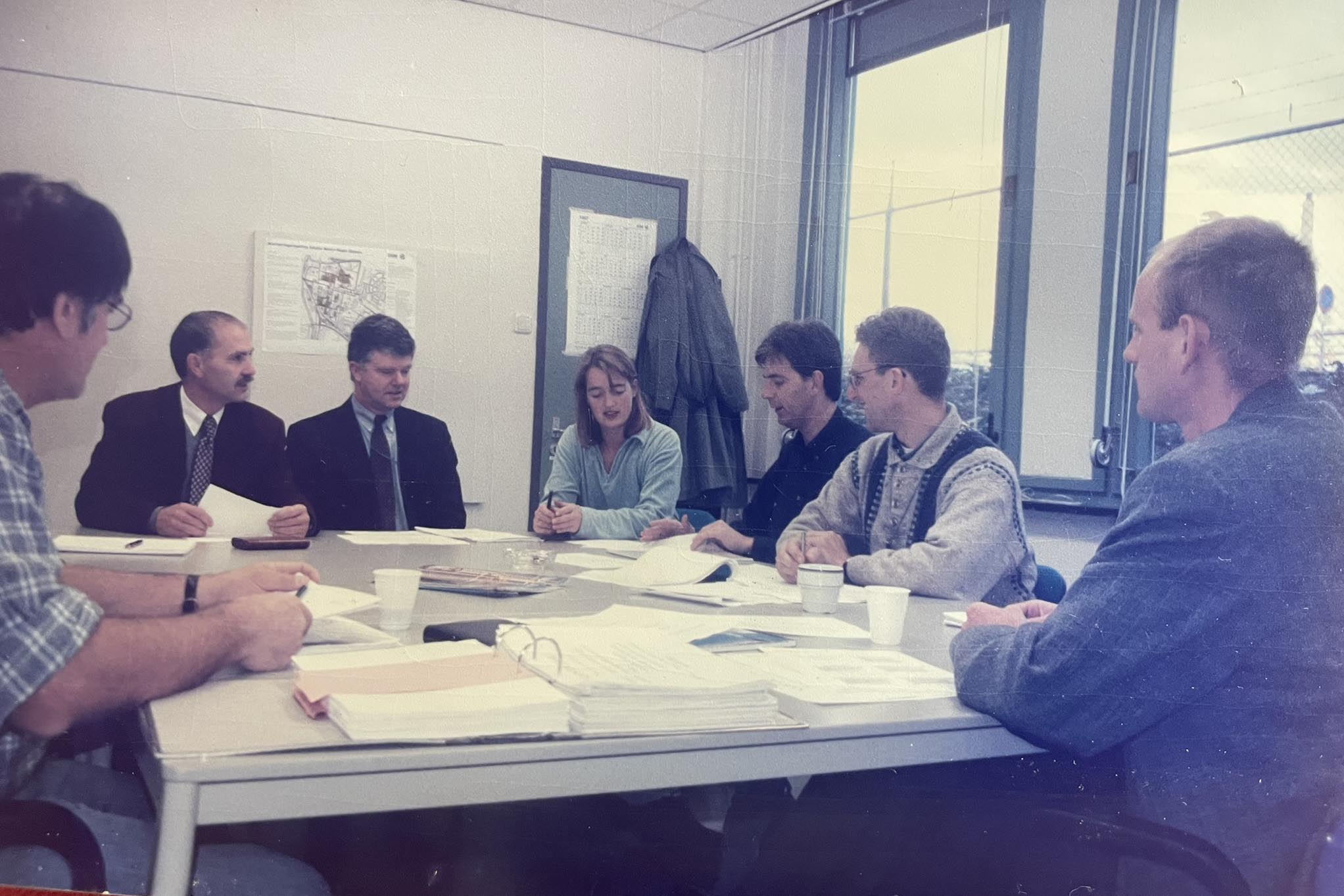
There is a photograph on the wall next to my workplace at home.
At first sight, there is not much to it. It shows a small, rather bare conference room, with my team and me sitting around a table, together with an HR colleague and a consultant. On the table are some documentation folders and the ubiquitous white plastic coffee cups. There is little else in the room.
The photograph was taken arouind 1997 during a period when we were being coached in a new way of working: empowerment.
It was actually published in DSM Nieuws, the company’s internal newspaper, as an example of the work we were doing.
At the time, our team had quite a challenge. We were dealing with the “child diseases” of the newly started phenylglycine-amide plant that used a new technology. The business need of getting the plant to run properly put considerable pressure on the team — and on me as its leader.
The empowerment coaching therefore wasn’t some theoretical management exercise. We had real problems to solve and real pressure to deliver.
Two sides of empowerment
I experienced the coaching from two different sides.
As the team leader, I learned a different way of leading people.
The lesson was not simply “give people freedom”. It was more subtle: don’t prescribe; challenge.
Instead of telling someone how to solve a problem, I should challenge them to think through the problem themselves. What are you trying to achieve? What have you considered? What prevents you from getting there? What alternatives do you see?
The responsibility for the solution remained with the professional doing the work.
But I was also being coached from the other side — as a team member myself.
The HR colleague and consultant would sometimes accompany me when I had to go to my own manager to ask for money, people or other resources. I was learning how to operate within the organisation in the same way that I was learning to lead my own team.
The message was essentially the same in both directions.
I had responsibility for an outcome, but I also had to take responsibility for finding the way to achieve it.
That meant making a case for what I needed, challenging assumptions, negotiating for resources and taking ownership of the result.
The photograph returns
At the time, I probably did not think of the photograph as particularly important. It was simply a picture of a team, an HR colleague and a consultant, documenting one of DSM’s empowerment initiatives.
Almost twenty years later, it came back to me.
MyDSM departmenthad moved into a new building with open offices. There were no cupboards for storing large quantities of paper, so we had to get rid of much of the paper that had accumulated over the years.
The same HR colleague moved into the new building with us. While clearing out his own paper archive, he came across the photograph.
He gave it to me.
I was very happy to receive it.
It was a small piece of my professional history that had unexpectedly survived the transition to a paperless office.
And it is still on the wall next to my workplace today.
What I learned
Looking back, the most important thing about the photograph is not the plant, the team or even the empowerment programme itself.
It reminds me of a way of working that became deeply ingrained in me.
The basic idea was remarkably simple:
The what is given. The how is yours.
You are given a goal, a timeframe and the constraints within which you have to operate. Then you are expected to work out how to achieve the goal.
As a leader, your job is not to prescribe the solution. Your job is to challenge, coach and remove obstacles.
As a professional, your job is not to wait for instructions. You are expected to use your expertise, creativity and judgement to find a way forward — and to take responsibility for the result.
After a while, this stops feeling like a particular management philosophy. It becomes what you consider normal.
That happened to me.
I only realized this much later
When I received the photograph, Covestro was still far in the future. I had no reason to connect this small piece of DSM history with anything that would happen later in my career.
On 1 April 2021, the DSM business I had worked in moved to Covestro. I followed it.
The plants were largely the same. Many colleagues were the same. The technical problems were the same.
But the organisational environment was different.
And that is when the photograph acquired a new meaning for me.
It made me realize that what I had come to regard as a normal way of working was not simply how professional organisations work. It was the result of a particular culture in which I had spent more than thirty years.
I had been trained in empowerment — not just intellectually, but through actual experience, pressure, coaching and practice.
And I had carried those instincts with me.
From empowerment to intrapreneurship
There is another consequence.
If you are given the objective but are allowed to determine how to achieve it, you inevitably start operating a little like an entrepreneur inside the organisation.
You have to find the right people, obtain resources, build relationships, overcome obstacles and make things happen. You cannot simply say that the prescribed solution doesn’t work. The outcome is yours.
I now recognize this as a form of intrapreneurship.
It also explains something about the little “shop” I described in my earlier post: why it felt quite natural to me to take ownership of a small domain within Covestro and run it with considerable independence.
I did not set out to become an intrapreneur. By then, I had simply been working that way for a very long time.
For now, the photograph remains on my wall.
A photograph from around 1997, rescued from a paper archive almost twenty years later, has become a reminder of something I didn’t fully appreciate at the time:
The most lasting part of empowerment is not what you are taught. It is what eventually becomes your instinct.
And that instinct stayed with me for the next thirty years.
When I moved from DSM to Covestro on 1 April 2021, I did not only move to another company. I also brought with me a small piece of the DSM world.
For the past five years, I have managed a number of MES implementations (computer systems for production management) that had originally been developed within DSM. The systems were running in manufacturing plants that moved from DSM to Covestro, and I moved with them.
These systems were never really part of Covestro’s standard MES landscape. They were, in a sense, legacy systems from the moment I arrived. There was therefore a fairly clear expectation that they would eventually be replaced by a Covestro solution.
“Eventually”, however, turned out to be a rather elastic concept.
In the meantime, the systems continued to do useful work. They provided historian data, but their role went considerably further. We collected batch-performance data from daily operations and used those data for Continuous Improvement. Within Covestro’s Analytical Platform, the data could be summarized and transformed into analyses that provided pointers to further process improvements.
There was also a less glamorous but very practical benefit. By automating recurring reporting and analyses, the systems took work away from local engineers and management. Some of the activities were simply tedious: producing regular reports, preparing statistics, or doing things such as annual target setting. Once the relevant data were available in a structured form, much of that work could be automated.
So although the systems were “non-standard”, they were not exactly redundant.
Running my own shop
What made my role interesting was that I was not simply the application administrator of an existing corporate system. Over time, I effectively had my own little “shop” within Covestro.
I was responsible for the whole environment: costs, IT interfaces, Managed Operations, migrations, extensions to the functionality, and all the practical things needed to keep the systems running and developing.
There was no large team behind me doing these things. In practice, I had to find the people I needed, arrange the interfaces, manage the suppliers and operations, decide what needed to be changed and make sure that the result worked.
Looking back, “intrapreneur” is probably a better description of what I was doing than “system manager”. I operated inside a large company, but with considerable independence. I had a small domain that I was responsible for and, within that domain, I had to make things happen.
Of course, that independence also meant that I sometimes felt rather detached from the mainstream Covestro organisation.
The museum
There was a particular place where this became almost a running joke.
In Geleen, there were still quite a few people around who had worked at DSM before the transition. Some were now at Covestro, while others had moved with parts of the old DSM organisation into successor companies.
During breaks and lunches, we would sometimes compare experiences. We would wonder about things that had changed after the transition, discuss things that we found difficult to understand, and, perhaps most importantly, laugh about them.
That laughter was useful. When something frustrates you, being able to tell the story to someone who immediately understands why it is frustrating makes quite a difference. And when you can laugh about it together, the frustration becomes easier to handle.
At some point I started referring to my little MES environment as my “museum”.
It was an appropriate name. The systems had their roots in an earlier DSM era, and I was still running them years after the organisation around them had changed.
One former colleague, now working at Envalior, took the joke a step further. Whenever we met — sometimes with other people around — he would address me as “Museum Director”.
I found that funny.
It also gave me an opportunity to explain what my “museum” actually contained. And the more I explained it, the more obvious it became that it wasn’t really a museum at all. It was still doing useful work.
There was something interesting about that wider Geleen community. It was not only a community of people from the same company. It included people who had ended up in quite different organisations but who had shared the same DSM background. Envalior is an interesting example: its engineering-materials business combines former DSM engineering plastics with the former LANXESS high-performance materials business. They too have been going through a transition in which an old organisational culture meets a new corporate environment. Maybe even similar, because LANXESS is also a Bayer successor, like Covestro.
We therefore had something in common that was difficult to describe in organisational charts. We recognised similar changes in the way work was organised, similar differences in expectations, and sometimes similar frustrations — even though we were no longer colleagues.
That community turned out to be valuable.
When a legacy system becomes useful
Meanwhile, the replacement of my “museum” was progressing — or, more accurately, being discussed for quite a long time before it actually progressed.
For years, the systems were regarded as something that should eventually disappear because they were not the standard. Eventually Covestro did develop a replacement with similar functionality and started rolling it out, including to sites that were still using “my” MES solution.
The plan is now to retire the legacy systems by the end of 2026.
There is a certain irony in the timing.
After years of having systems that were considered non-standard, the standard replacement has finally arrived. And it arrives just in time: in about six months, my retirement will lead to the wind-down of my activities for Covestro anyway.
The “museum” is therefore finally closing.
But the work continues
I am not completely leaving the story behind.
Within the replacement project, I still have a role in developing the new data platform. In essence, this is a 2.0 version of what I have been running.
The new platform goes a step further. It provides ready-to-use datasets for batch and batch-step analyses, including things such as duration histograms and statistical analyses. These data can then be used to derive manufacturing and scheduling targets.
That is actually the part I find most satisfying.
The systems themselves are technology. Technology has a lifecycle, and eventually old systems should be replaced. There is nothing wrong with that.
What matters more is what you do with the data — and the way you think about using them.
So, after all those years, my systems will probably not survive me.
But there is a fair chance that the way I worked with the data will.
And perhaps that is a better legacy for a Museum Director anyway.
For all episodes about Career in the correct sequence please follow this link.
This is the start of a main topic about my work career that started 1 February 1985 and will end end of March 2027.
The most recent period, starting 1 April 2021 was with Covestro, a German chemical and materials company that was once part of the legendary Bayer, one of the great traditional companies of Germany.
An observation arises when something catches your attention. Usually this happens because it differs from what you are used to, surprises you, or interests you enough to remember it and try to understand it. But it can also happen when something familiar confirms a pattern you already recognize. Or, alternatively, if you see a familiar pattern that fits a backdrop.
Specifically the observations around my time in Covestro has three backdrops:
My professional background. Until 1 April 2021, I had spent a long period working at DSM, where I had been trained in a particular company culture. I had grown up professionally in that culture and had been part of the journey that shaped it. Things I encountered at Covestro sometimes contrasted sharply with what had become familiar to me at DSM.
My personal experience of Germany. My wife is German, born and raised in Cologne, close to Leverkusen and through her I have become familiar with German family life and culture. Working in a German company sometimes revealed differences between the Germany I knew privately and the Germany I encountered professionally. These differences became another source of observations.
The border. I live a few hundred meters from the Dutch-German border. Crossing the border is enough to encounter visible differences in everyday life. This has made me particularly conscious of differences between the two countries.
My observations are about culture and ways of working, not about individual people. I have worked with many good and enjoyable colleagues throughout my career, including at Covestro.
From time to time, I was frustrated at Covestro. I see this primarily as my problem, rather than as a judgement about Covestro. My professional culture had taught me to take the lead in achieving relevant results and to use my own creativity to find the best way of getting there. I had come to believe strongly in that way of working.
My frustration arose when I encountered a different approach. Decisions taken by (higher) management were often treated as unalterable, even when they appeared not to work. Even raising the question of whether such a decision should be reconsidered could be difficult. The same applied to requirements, rules and norms: even when they seemed irrelevant to a particular situation, counterproductive, or sometimes inconsistent with other requirements, they were nevertheless to be followed.
Another source of frustration was the tendency to prescribe in detail what to do rather than what to achieve. This was particularly difficult when the people prescribing the solution did not have the relevant expertise and therefore did not necessarily see the consequences of what they were asking, while at the same time leaving little room for a discussion of the substance.
I entered Covestro with one set of assumptions about how an effective organisation works, and encountered another set of assumptions. The differences made me notice things that I might otherwise never have noticed.
In subsequent posts, I will describe some anecdotes that illustrate these observations and, hopefully, make the differences more tangible.
I welcome reactions and different perspectives; you can always contact me
Outline of published and planned episodes
Act I — The Covestro question What did I encounter, and why did it strike me as unusual?
Act II — The DSM backdrop Where did my expectations come from, and what did empowerment actually mean in practice?
Act III — Back to Covestro Now that the reader knows my reference frame, what did I actually observe and feel?
Act IV — Farewell Put “observations from a career” into perspective and final remarks